
环太平洋
红米红饭注7现场照片欣赏:双面玻璃,幻影渐变_我的网站

A |
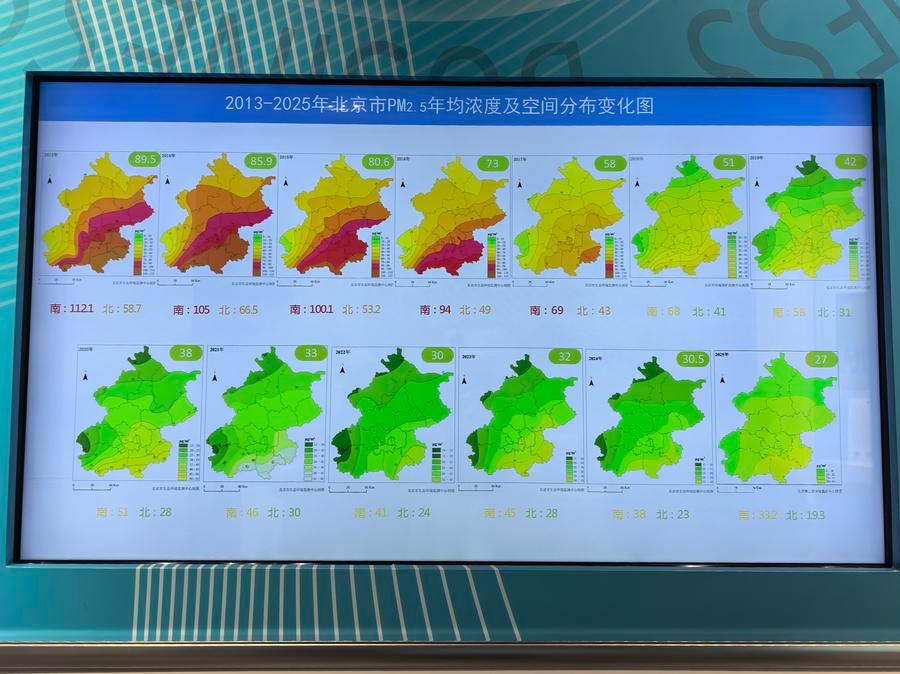
In 2025, Beijing recorded 311 days with good air quality and only one heavily polluted day, compared with 58 heavily polluted days in 2013, when the city officially began releasing PM2.5 monitoring data. The annual average PM2.5 concentration, a key indicator of air quality, fell from 89.5 micrograms per cubic meter in 2013 to 27 micrograms per cubic meter in 2025, a decline of nearly 70 percent.
The progress has drawn international attention. The United Nations Environment Programme has highlighted Beijing's experience in improving air quality as a model for other cities.
According to experts at the Beijing Municipal Ecological and Environmental Monitoring Center, the cleaner air is the result of a comprehensive system integrating environmental monitoring, scientific analysis, policymaking, regional cooperation and law enforcement -- with digital technologies now woven into every link of that chain.
MORE TARGETED APPROACH
Effective governance begins with accurate monitoring. Beijing has established a multi-level air-quality monitoring network. Figures show 35 standard monitoring stations across the city continuously measure six major pollutants, while more than 1,000 compact sensors deployed across communities and townships provide more detailed information on local air-quality variations.
The monitoring system was gradually built by the Beijing Municipal Ecological and Environmental Monitoring Center, one of China's earliest ecological and environmental monitoring institutions, responsible for monitoring Beijing's air, water, noise, soil environments and ecosystems.
The center has developed an analytical system that can identify around 125 components of PM2.5, covering most of its composition and helping researchers trace pollution sources.
"Source analysis helps us identify the major contributors to pollution at different stages, providing a scientific basis for policymakers to target key emission sources," said Li Yunting, technical director at the center.
Coordinated by the Beijing Municipal Ecology and Environment Bureau, the center has conducted four rounds of PM2.5 source analysis studies with other institutions, with results released in 2014, 2018, 2021 and 2025.
The latest analysis showed that regional transport contributed 57 percent of Beijing's PM2.5 pollution. Among local sources that accounted for the remaining 43 percent, vehicle emissions and residential sources represented the largest share of pollution, a distinctive characteristic of a major international metropolis.
The monitoring results have provided scientific support for a series of pollution-control measures. For example, Beijing has promoted new-energy vehicles to reduce transport emissions and adopted advanced techniques, including air-supported membrane structures, to control dust emissions. Meanwhile, coal combustion pollution, once a major contributor, has almost been eliminated and is no longer listed among the main sources, reflecting broader national efforts to reduce coal consumption, promote clean energy and upgrade heavily polluting industries.
With PM2.5 concentrations now at relatively low levels, further gains in air quality will depend on more targeted, science-driven approaches.
SMARTER ENVIRONMENTAL GOVERNANCE
Beyond monitoring pollution, Beijing has built a data-driven environmental governance system that links monitoring, regulation and enforcement in a closed loop from detection to action and follow-up evaluation.
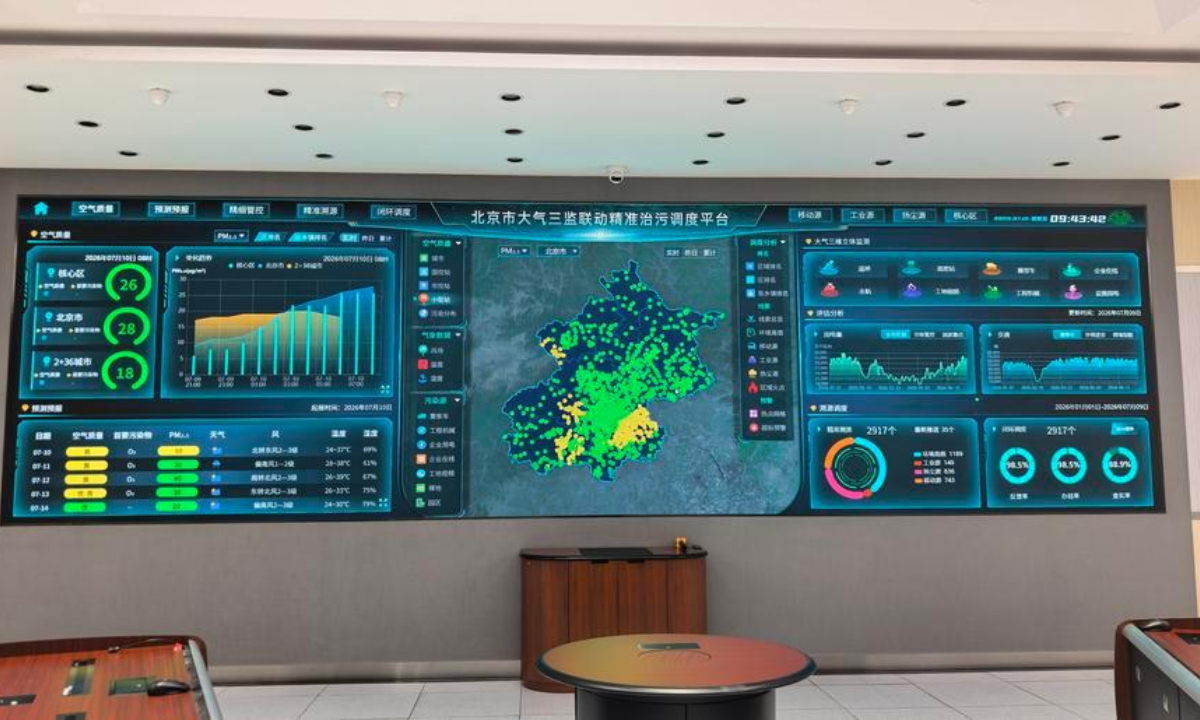
Developed by the center and known as the innovative regulation-monitoring-inspection linkage model, the system integrates artificial intelligence, the Internet of Things, satellite remote sensing and vehicle-mounted monitoring technologies to pull together environmental data from multiple sources onto a unified platform.
"The system brings information that was once scattered across different departments onto a single platform," said Zhang Likun, director of the smart system division at the center, adding that this enables off-site enforcement and joint cross-sector actions involving housing, water resources and transportation, significantly improving the efficiency and precision of environmental management.
Using more than 30 intelligent algorithms, the platform automatically analyzes data and identifies potential pollution risks, based on which monitoring staff identify the most pressing problems and forward them to enforcement departments.
The approach has already drawn international attention. Clean Air Asia, an international nongovernmental organization focused on improving air quality across Asia, featured the system as a representative case study in its "China Air 2025" report. The model was also presented at the 2026 Better Air Quality Conference and recognized with the Certificate for Clean Air Best Practice Sharing.
China has integrated ecological conservation into its modernization drive. As the country speeds up efforts under the Beautiful China Initiative, Beijing's experience demonstrates how technology can support more precise, coordinated and sustainable environmental governance.
。1月10日下午消息,小米公司召开了新的自主品牌红米红米大会,正式推出红米纸条7,搭载全血版毛龙660处理器,红米纸条73 32GB版999元,4 64GB版1199元,6 64GB版1399元,今晚6点,1月15日上午10点的现货销售。Redmi Red Rice Note7采用6.3英寸水滴全屏幕,点胶工艺,1.95mm极窄框架,覆盖2.5d双面玻璃,康宁大猩猩第五代玻璃罩,后指纹识别,渐变设计,提供三种颜色选项:微光金、梦幻蓝、亮黑;机身背面同步Sly使用了Redmi全新的标志。

B | Redmi Red Rice Note7配备“全血版”550处理器,14nm工艺,2.2GHz主频,4000 mAh电池配备新石墨负极,支持QC 4协议。在小米商城购买一台新机器时,可加10元购买一款18W毫米USB快速充电充电器,充电时间1小时43分钟。对于摄影,Red Rice Note7搭载4800万像素和500万像素的AI双摄像头,在1.6微米的大像素高灵敏度模式下在黑暗环境下自动四倍拍摄,以及超级夜景支持。

C | 否则,红米注7标准C型接口,还保留了3.5毫米耳机孔,红外遥控。本机还采用DSM动态增益控制和定制AAC微型扬声器。

D | 外部放大的体积增加了2.5倍。设计了0.64cc独立音箱扬声器。

E | 音量大,音效好。

F | 雷军还介绍了红米饭的质量说明7,其中包括许多质量奖。机身采用四角保护设计,增强局部强度;键/接口防水设计,支持防溅;微裂纹边缘抛光工艺,增强韧性,增强抗压强度,手机也提供18个月的质量保证。北京东小米红饭注7幻影渐变人工智能双相摄影4GB 64GB梦蓝网通4G双卡双待水滴全屏照片游戏智能手机1199元以下直接链接更是现场照片欣赏:。
Current article:http://zgwt.minshixuanhabing.bond/6pwd/20260826/245.html
Published on:09:57:13
我的网站最近更新
- 众泰“亡者归来” T300车型即将复产:5万元交个朋友
- 中俄亮出“敌国条款”!必要时可动用五常特权,高市早苗傻眼了,犀牛老师观点,原创 中俄亮出“敌国条款”!必要时可动用五常特权,高市早苗傻眼了
- 省自然资源厅技术人员到旧门满族乡监测信息
- Elon Musk calls Shanghai 'a Great City' as mother shares China trip
- 23 humanoid robot teams compete in rescue missions at 2nd WHRG, facing real-world complexity beyond dancing in coordination
- 坐滩舰断粮50天?终于收到中方放行,菲军该庆幸对手是中国,周扒皮侃历史,原创 坐滩舰断粮50天?终于收到中方放行,菲军该庆幸对手是中国
- 《再见爱人5》“霸总嘉宾”路行背后:千万受贿案,三年亏损路?
- UNSC Expansion Would 'Certify Transition From US Unipolarism to Multipolarity': Scholar
- PM to inaugurate Kisan Samman Sammelan on Monday
- 让不同智能体一起干活,难在哪?
- 大调整!iPhone 15 Pro Max或改名为iPhone 15 Ultra_系列_机型
- 前国足队长带队0-13惨败越南球队 47分钟丢9球 董路回应
- 英特尔确认 "Diamond Rapids" 至强处理器可扩展至 256 核心
- 牦牛闯入四川黄龙景区五彩池 官方通报:禁牧围栏遭人为破坏
- 轰1杆破百+8杆50+!赵心童10-4轻取去年亚军,强势跻身世锦赛16强
- 美国政府紧急下场救市难解美债危局,美国政府紧急下场救市难解美债危局
- Alef首次推出Model A飞行汽车 并希望从2025年开始销售
- 市委常委会2026年调研成果交流会召开 刘强主持 于海田孙开连出席
- 整整18天折磨!被电击暴打!英国海归被高薪骗至缅甸:很多人有去无回
- 迪马济奥:博洛尼亚有意鲁文·巴尔加斯,和奥林匹亚科斯争抢球员
- 财政部:财政金融协同促内需政策已经优化完善 8月1日起实施,财政部:财政金融协同促内需政策已经优化完善 8月1日起实施
- 美疾控中心:新冠肺炎或将连续三年成美国致死率第三高的疾病
- 辽宁省旅游接待规模位列全国前十
- 蚂蚁集团组织了一支「物理AI特工队」:蚂蚁灵波具身路线的优势与困顿
我的网站热门资讯
- 经济发展局将额外投入3200万元 推动与初创企业合作
- 13日0时至15时 北京新增本土新冠肺炎病毒感染者16例
- 《香港文学》刊行500期扎根香港面向世界
- 三部门发文 推进家庭医生签约服务
- 【品种策略】棉花:08月26日多家期货公司晨报观点汇总
- 制造业投资增速106.4% 拱墅算力经济的向新答卷
- 「そして、お知らせです」…「サン!シャイン」佐々木恭子アナ、エンディングで発表「キャリアの作り方…どうやって自分の中で生き方を見つけて…」
- 英伟达确定在Rubin中使用M9材料,A股谁能受益?| 1022 张博划重点
- 快船0-1落后!ESPN预测明天胜率:掘金58.3%仍被看好 快船41.7%
- SL tourism earnings fall in Sep
- 三亚征集住宿行业重大活动期间价格违法线索,三亚征集住宿行业重大活动期间价格违法线索
- 限量发售200台 别克昂科威S 25T进享白金版新增丹霞红内饰
- 美团外卖,美团客服
- 开源,浙产大模型向世界敞开大门
- 仅重45Kg的全自动核酸检测平台获批上市:可无人值守放置桌面_之江_上海
- 正虹科技:上半年营业收入5.69亿元,同比增长14.19%
- 国家能源局:截至7月底,全国累计发电装机容量40.8亿千瓦,同比增长11.0%
- 2026成都车展 自主强势占位!比亚迪连续三年“包馆”、“暗藏”颠覆性技术 长城半馆坐镇
- 商家代练服务开挂,导致买家账号封号
- 哈登和库里的差距是怎么拉开的?而留给库里的时间还有多久?
- Ranbir Kapoor to Make a Power-Packed Cameo in Prabhas’ Spirit ?
- 双色球一等奖7注747万元,奖池6.28亿元
- 中国餐饮品牌“出海”新解,中国餐饮品牌“出海”新解
- 弗拉格长高5厘米!侠媒高赞上限超过文班亚马 肌肉维度过小正苦练